Large growing surface
Geometry is designed around light, climate, hydraulic performance, and site constraints.
Open ponds and photobioreactors grow algae suspended in water. Aeroponic Algal Culture (AAC) is designed to supply nutrient-bearing water to algae growing on exposed, rigid surfaces.
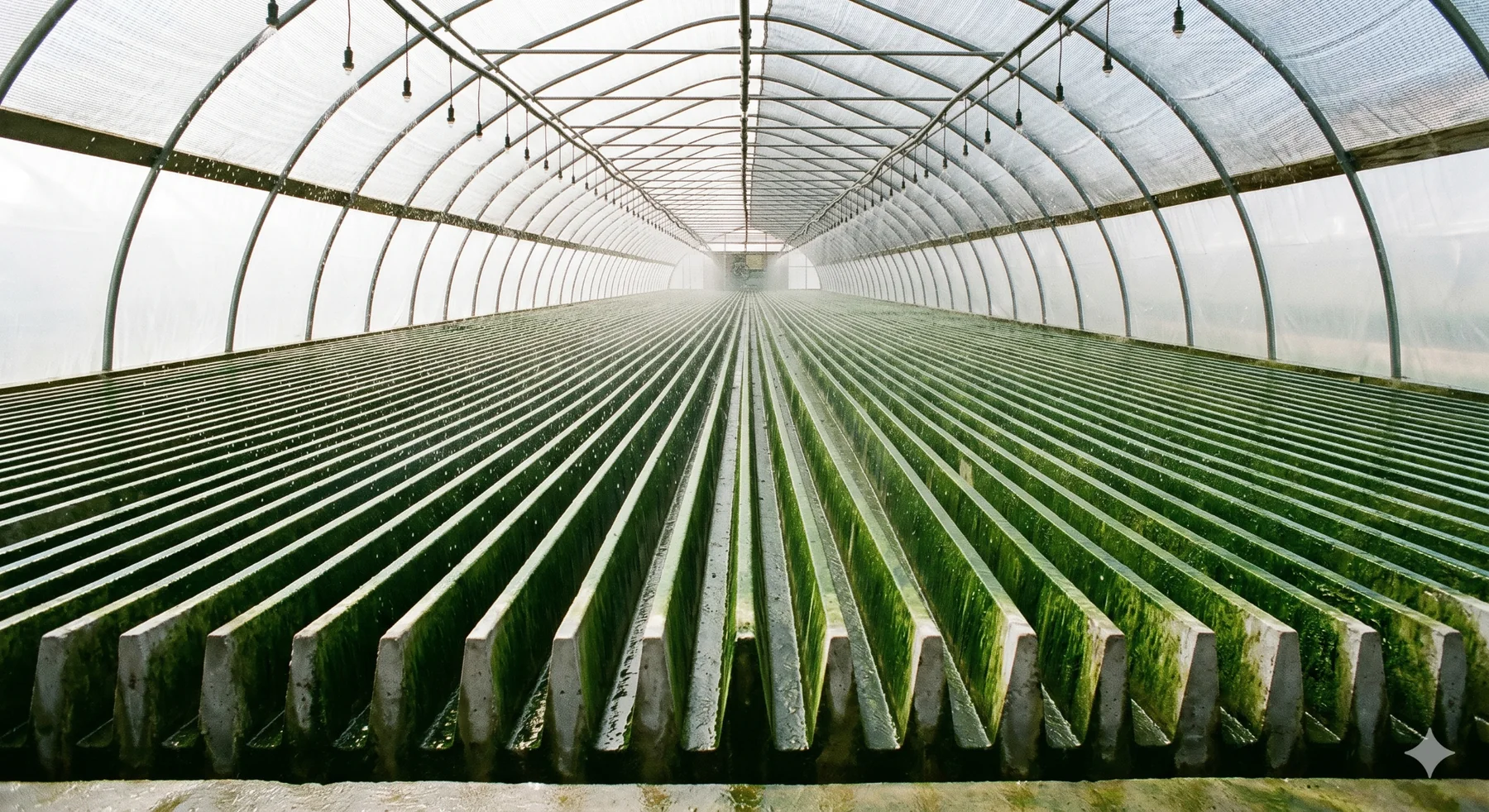
AAC treats wastewater primarily as a nutrient-delivery medium. The algae is intended to live on fixed, exposed infrastructure, not as a dilute suspension throughout the treatment volume.
Nutrient-bearing water is distributed across the surface. Algae grow as an attached biofilm, incorporating nitrogen and phosphorus into biomass. That biomass is removed directly from the rigid surface and measured as part of treatment performance.
The ridge geometry is intended to place substantially more active algal growing surface within a facility footprint while keeping the biofilm exposed and accessible.
Geometry is designed around light, climate, hydraulic performance, and site constraints.
Nutrient-bearing moisture supplies attached growth without making the entire water volume the growth chamber.
The primary growing surfaces remain fixed during normal operation.
Exposed rigid surfaces are intended to support inspection, maintenance, and mechanical harvesting.
Earlier attached-growth systems demonstrated an important principle: algae can grow as a harvestable biofilm on a surface rather than remaining suspended throughout a water volume. AAC applies that principle to fixed, exposed, rigid infrastructure.
Shallow basins cultivate algae suspended throughout a large water surface.
Transparent tubes or panels cultivate suspended algae in a more enclosed and controlled water volume.
Algae grow as a biofilm on media, making the biomass more accessible than a dilute suspended culture.
| Design challenge | Open ponds | Photobioreactors | Earlier attached-growth systems | AAC design intent |
|---|---|---|---|---|
| Light | Penetrates a shallow water layer; dense culture self-shades | Enters through transparent vessels; fouling can reduce transmission | Biofilm grows closer to light | Expose the active biofilm directly on fixed surfaces |
| Carbon transfer | Mixed through water or absorbed from air | Often injected and circulated | Varies by geometry | Use thin films and a large air-water-biofilm interface |
| Harvest | Separate dilute cells from the pond water | Separate suspended cells from the reactor water | Remove biofilm from media | Remove biomass directly from rigid surfaces |
| Surface density | Primarily horizontal | Determined by vessel geometry and spacing | Often limited by screen, belt, or support geometry | Fold active growing surface into a compact footprint |
| Infrastructure model | Pond earthwork | Specialized transparent process equipment | Often mechanical or flexible assemblies | Permanent civil infrastructure with serviceable equipment |
Algal growth captures nutrients in biomass. Harvest completes the treatment by physically carrying that nitrogen and phosphorus out of the water system.
Algae and associated microorganisms incorporate available nutrients into cellular material.
Biomass is taken off the growth surface, carrying nutrients out of the water system.
Testing determines whether the harvested material is suited to industrial processing, energy recovery, nutrient recovery, or safe managed handling.
Every deployment must be configured around source water, nutrient load, flow, climate, land, treatment objectives, discharge requirements, biomass restrictions, and operating resources.
Municipal effluent, food-processing water, direct industrial discharge, and agricultural drainage differ in nutrient form, organics, pathogens, contaminants, variability, and permitted downstream pathways.
Temperature, solar exposure, wind, land, hydraulic elevation, service access, winter operation, and community context shape the facility.
Flow and concentration determine the annual nitrogen and phosphorus load. Nutrient balance, availability, and carbon then constrain algal production.
The relevant goal might be nitrogen reduction, phosphorus recovery, seasonal polishing, compliance, watershed restoration, industrial reuse, or an integrated combination.